Neutrogena Rapid Clear Acne Eliminating Spot Gel With Salicylic Acid
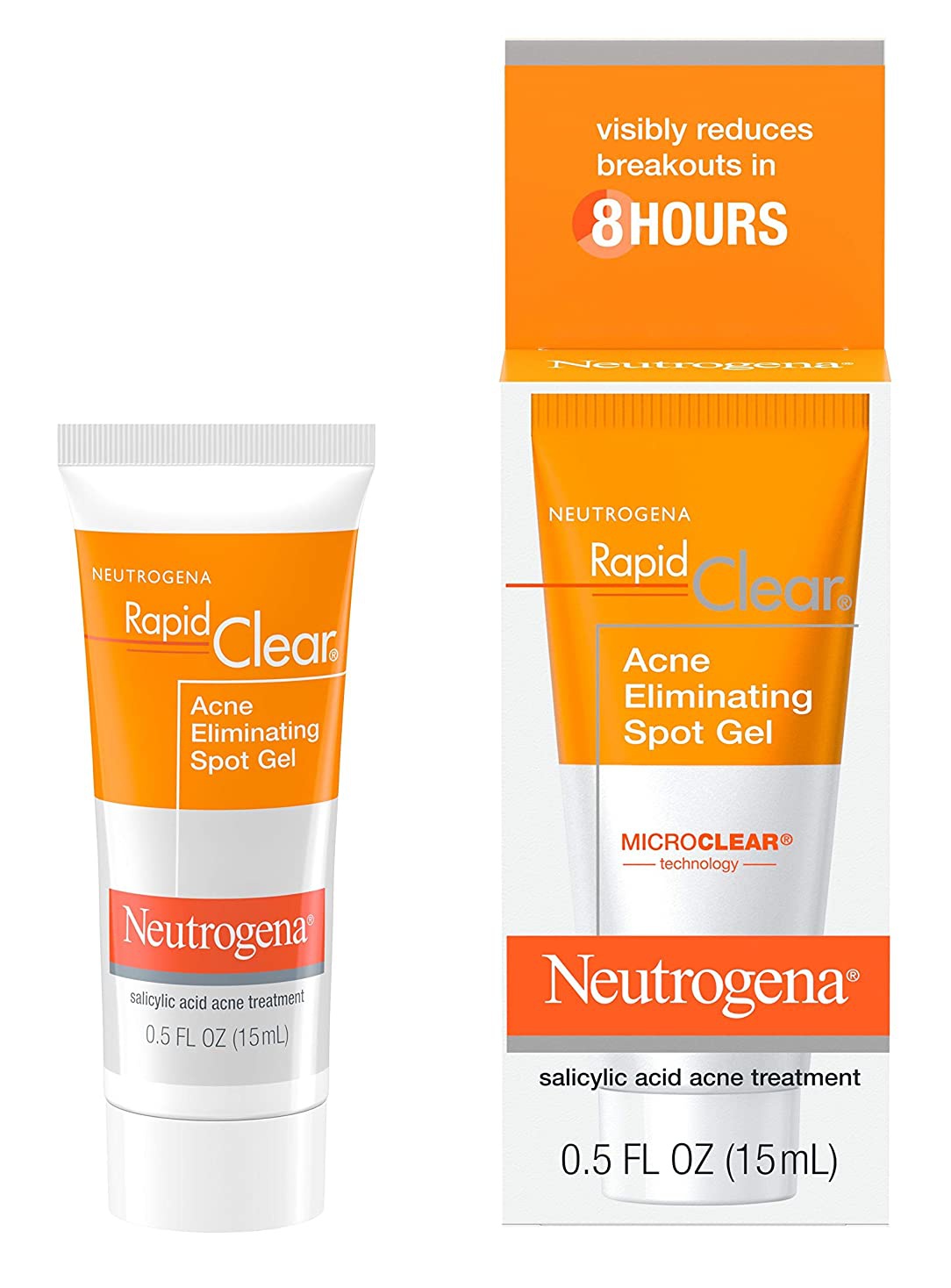
Rapid Clear Acne Eliminating Spot Gel
This gel is a maximum strength acne treatment for breakout emergencies. It clears breakouts fast and helps prevent emerging breakouts even before they become visible.
Uploaded by: landsharkknight27 on
Ingredients overview
Inactive Ingredients: Water, Alcohol Denat, Hamamelis Virginiana (Witch Hazel) Water, Polyacrylamide, Glycerin, C13-14 Isoparaffin, Cyclopentasiloxane, C12-15 Alkyl Lactate, Alcohol, Laureth-7, Phenoxyethanol, Cetyl Lactate, PPG-2 Isoceteth-20 Acetate, Cocamidopropyl Pg-Dimonium Chloride Phosphate, Polysorbate 20, Phenethyl Dimethicone, Fragrance, Dehydroxanthan Gum, Propylene Glycol, Benzalkonium Chloride, Ammonium Hydroxide, Tetrasodium EDTA, Butylene Glycol, Capryloyl Glycine, Sarcosine, Cinnamomum Zeylanicum Bark Extract, Cedrus Atlantica Bark Extract, Portulaca Oleracea Extract
Highlights
Key Ingredients
Other Ingredients
Skim through
| Ingredient name | what-it-does | irr., com. | ID-Rating |
|---|---|---|---|
| Salicylic Acid (2%) | exfoliant, anti-acne, soothing, preservative | superstar | |
| Water | solvent | ||
| Alcohol Denat | antimicrobial/antibacterial, solvent, viscosity controlling | icky | |
| Hamamelis Virginiana (Witch Hazel) Water | soothing | goodie | |
| Polyacrylamide | viscosity controlling | ||
| Glycerin | skin-identical ingredient, moisturizer/humectant | 0, 0 | superstar |
| C13-14 Isoparaffin | emollient, viscosity controlling, solvent | ||
| Cyclopentasiloxane | emollient, solvent | ||
| C12-15 Alkyl Lactate | emollient | ||
| Alcohol | antimicrobial/antibacterial, solvent, viscosity controlling | icky | |
| Laureth-7 | emulsifying, surfactant/cleansing | ||
| Phenoxyethanol | preservative | ||
| Cetyl Lactate | emollient | ||
| PPG-2 Isoceteth-20 Acetate | emulsifying | ||
| Cocamidopropyl Pg-Dimonium Chloride Phosphate | |||
| Polysorbate 20 | emulsifying, surfactant/cleansing | 0, 0 | |
| Phenethyl Dimethicone | emollient | ||
| Fragrance | perfuming | icky | |
| Dehydroxanthan Gum | viscosity controlling | ||
| Propylene Glycol | moisturizer/humectant, solvent, viscosity controlling | 0, 0 | |
| Benzalkonium Chloride | antimicrobial/antibacterial, preservative, surfactant/cleansing | ||
| Ammonium Hydroxide | buffering | ||
| Tetrasodium EDTA | chelating | ||
| Butylene Glycol | moisturizer/humectant, solvent, viscosity controlling | 0, 1 | |
| Capryloyl Glycine | surfactant/cleansing | ||
| Sarcosine | goodie | ||
| Cinnamomum Zeylanicum Bark Extract | antimicrobial/antibacterial, antioxidant, emollient, moisturizer/humectant, perfuming | ||
| Cedrus Atlantica Bark Extract | perfuming | ||
| Portulaca Oleracea Extract | soothing, antioxidant | goodie |
Neutrogena Rapid Clear Acne Eliminating Spot Gel
Ingredients explained- It's one of the gold standard ingredients for treating problem skin
- It can exfoliate skin both on the surface and in the pores
- It's a potent anti-inflammatory agent
- It's more effective for treating blackheads than acne
- For acne combine it with antibacterial agents like benzoyl peroxide or azelaic acid
Read all the geeky details about Salicylic Acid here >>
Also-called: Aqua | What-it-does: solvent
Good old water, aka H2O. The most common skincare ingredient of all. You can usually find it right in the very first spot of the ingredient list, meaning it's the biggest thing out of all the stuff that makes up the product.
It's mainly a solvent for ingredients that do not like to dissolve in oils but rather in water.
Once inside the skin, it hydrates, but not from the outside - putting pure water on the skin (hello long baths!) is drying.
One more thing: the water used in cosmetics is purified and deionized (it means that almost all of the mineral ions inside it is removed). Like this, the products can stay more stable over time.
- It's a super common and super debated skincare ingredient
- It has several benefits: great solvent, penetration enhancer, creates cosmetically elegant, light formulas, great astringent and antimicrobial
- It can be very drying if it's in the first few ingredients on an ingredient list
- Some experts even think that regular exposure to alcohol damages skin barrier and causes inflammation though it's a debated opinion (read more in geeky details tab)
Read all the geeky details about Alcohol Denat. here >>
Thedistillate created from different parts of the hazelnut-bush-like magic tree, commonly called Witch Hazel. Hamamelis Virginiana Water is a bit of a sloppy ingredient name as the leaves, the twigs and the bark can be used to create extracts or distillates and the different parts contain different amounts of biologically active components. But what you are getting is probably a nice water withastringent, soothing, antioxidant and antibacterial magic properties.
We went into great detail about Witch Hazel in cosmetics here, detailing the main biologically active components and how they are different in different parts of the plant. Click here and read more >>
It's a film-forming and thickening polymer (a large molecule composed of many repeated subunits) that comes to the formula usually as part of an emulsifier, thickener trio (with C13-14 Isoparaffin and Laureth-7, trade named Sepigel 305). This trio is an easy-to-use liquid that helps to create nice, non-tacky gel formulas.
- A natural moisturizer that's also in our skin
- A super common, safe, effective and cheap molecule used for more than 50 years
- Not only a simple moisturizer but knows much more: keeps the skin lipids between our skin cells in a healthy (liquid crystal) state, protects against irritation, helps to restore barrier
- Effective from as low as 3% with even more benefits at higher concentrations up to 20-40% (around 10% is a good usability-effectiveness sweet spot)
- High-glycerin moisturizers are awesome for treating severely dry skin
Read all the geeky details about Glycerin here >>
It's a petroleum derived emollient and thickener. It often comes to the formula as part of an emulsifier, thickener trio (with Polyacrylamide and Laureth-7). This trio is an easy-to-use liquid that helps to create nice, non-tacky gel formulas.
A super commonly used 5 unit long, cyclic structuredsilicone that is water-thin and does not stay on the skin but evaporates from it (called volatile silicone). Similar to other silicones, it gives skin and hair a silky, smooth feel.
It's often combined with the non-volatile (i.e. stays on the skin) dimethicone as the two together form a water-resistant, breathable protective barrier on the skin without a negative tacky feel.
 We don't have description for this ingredient yet.
Simply alcohol refers to ethanol and it's a pretty controversial ingredient. It has many instant benefits: it's a great solvent, penetration enhancer, creates cosmetically elegant, light formulas, great astringent and antimicrobial. No wonder it's popular in toners and oily skin formulas.
The downside is that it can be very drying if it's in the first few ingredients on an ingredient list.
Some experts even think that regular exposure to alcohol damages skin barrier and causes inflammation though it's a debated opinion. If you wanna know more, we wrote a more detailed explanation about what's the deal with alcohol in skincare products at alcohol denat. (it's also alcohol, but with some additives to make sure no one drinks it).
A not-very-interesting helper ingredient that is used as an emulsifier and/or surfactant. Comes from a coconut oil derived fatty alcohol, lauryl alcohol.
It's pretty much the current IT-preservative. It's safe and gentle, but even more importantly, it's not a feared-by-everyone-mostly-without-scientific-reason paraben.
It's not something new: it was introduced around 1950 and today it can be used up to 1% worldwide. It can be found in nature - in green tea - but the version used in cosmetics is synthetic.
Other than having a good safety profile and being quite gentle to the skin it has some other advantages too. It can be used in many types of formulations as it has great thermal stability (can be heated up to 85°C) and works on a wide range of pH levels (ph 3-10).
It's often used together with ethylhexylglycerin as it nicely improves the preservative activity of phenoxyethanol.
We don't have description for this ingredient yet.
We don't have description for this ingredient yet.
We don't have description for this ingredient yet.
It's a common little helper ingredient that helps water and oil to mix together. Also, it can help to increase the solubility of some other ingredients in the formula.
We don't have description for this ingredient yet.
Also-called: Fragrance, Parfum;Parfum/Fragrance | What-it-does: perfuming
Exactly what it sounds: nice smelling stuff put into cosmetic products so that the end product also smells nice. Fragrance in the US and parfum in the EU is a generic term on the ingredient list that is made up of 30 to 50 chemicals on average (but it can have as much as 200 components!).
If you are someone who likes to know what you put on your face then fragrance is not your best friend - there's no way to know what's really in it.
Also, if your skin is sensitive, fragrance is again not your best friend. It's the number one cause of contact allergy to cosmetics. It's definitely a smart thing to avoid with sensitive skin (and fragrance of any type - natural is just as allergic as synthetic, if not worse!).
We don't have description for this ingredient yet.
- It's a helper ingredient that improves the freeze-thaw stability of products
- It's also a solvent, humectant and to some extent a penetration enhancer
- It has a bad reputation among natural cosmetics advocates but cosmetic scientists and toxicology experts do not agree (read more in the geeky details section)
Read all the geeky details about Propylene Glycol here >>
We don't have description for this ingredient yet.
We don't have description for this ingredient yet.
A handy helper ingredient thathelps products to remain nice and stable for a longer time. It does so by neutralizing the metal ions in the formula (that usually get into there from water) that would otherwise cause some not so nice changes.
Butylene glycol, or let's just call it BG, is a multi-tasking colorless, syrupy liquid. It's a great pick for creating a nice feeling product.
BG's main job is usually to be a solvent for the other ingredients. Other tasks include helping the product to absorb faster and deeper into the skin (penetration enhancer), making the product spread nicely over the skin (slip agent), and attracting water (humectant) into the skin.
It's an ingredient whose safety hasn't been questioned so far by anyone (at least not that we know about). BG is approved by Ecocert and is also used enthusiastically in natural products. BTW, it's also a food additive.
We don't have description for this ingredient yet.
We don't have description for this ingredient yet.
We don't have description for this ingredient yet.
We don't have description for this ingredient yet.
Portulaca Oleracea is a nice succulent with bright yellow flowers and edible nutritious vegetables. It's a famous plant in Korean traditional medicine to treat infection and irritated skin.
Modern research confirms that it's loaded with skin-goodies: it's the richest green plant source of omega-3 fatty acids (α-linolenic acid), contains NMFs (polysaccharides and amino acids),vitamins (β-carotene), minerals, and antioxidants (yellow betaxanthins and reddish betacyanins). Thanks to all its beneficial components, Purslane Extract has several magic properties: it's a great anti-inflammatory and antioxidant agent and also has wound healing abilities.
You may also want to take a look at...
One of the gold standard ingredients for treating problem skin. It can exfoliate skin both on the surface and in the pores and it's a potent anti-inflammatory agent. [more] Normal (well kind of - it's purified and deionized) water. Usually the main solvent in cosmetic products. [more] Alcohol with some additives to make it unconsumable. It is great solvent, penetration enhancer, creates cosmetically elegant, light formulas, great astringent, and antimicrobial. In large amounts, it can be very drying to the skin. [more] The distillate created from the hazelnut-bush-like magic tree, commonly called Witch Hazel. It might have astringent, soothing, antioxidant and antibacterial properties. [more] A film-forming and thickening polymer (a large molecule composed of many repeated subunits) that comes to the formula usually as part of an emulsifier, thickener trio. [more] A real oldie but a goodie. Great natural moisturizer and skin-identical ingredient that plays an important role in skin hydration and general skin health. [more] A petroleum-derived emollient and thickener. It often comes to the formula as part of an emulsifier, thickener trio. [more] It's a super commonly used water-thin volatile silicone that gives skin and hair a silky, smooth feel. [more] Simple alcohol that's a great solvent, penetration enhancer, creates cosmetically elegant, light formulas, great astringent, and antimicrobial. In large amount can be very drying. [more] A not-very-interesting helper ingredient that is used as an emulsifier and/or surfactant. Comes from a coconut oil derived fatty alcohol, lauryl alcohol. [more] Pretty much the current IT-preservative. It's safe and gentle, and can be used up to 1% worldwide. [more] It's a common little helper ingredient that helps water and oil to mix together. Also, it can help to increase the solubility of some other ingredients in the formula. The generic term for nice smelling stuff put into cosmetic products so that the end product also smells nice. It is made up of 30 to 50 chemicals on average. [more] A common glycol that improves the freeze-thaw stability of products. It's also a solvent, humectant and to some extent a penetration enhancer. [more] A helper ingredient that helps to neutralize the metal ions in the formula (that usually get into there from water) that would otherwise cause some not so nice changes. An often used glycol that works as a solvent, humectant, penetration enhancer and also gives a good slip to the products. [more]
Neutrogena Rapid Clear Acne Eliminating Spot Gel With Salicylic Acid
Source: https://incidecoder.com/products/neutrogena-rapid-clear-acne-eliminating-spot-gel
0 Response to "Neutrogena Rapid Clear Acne Eliminating Spot Gel With Salicylic Acid"
Post a Comment